
Why Clear Expectations and Strong Leadership Matter More Than Micromanagement
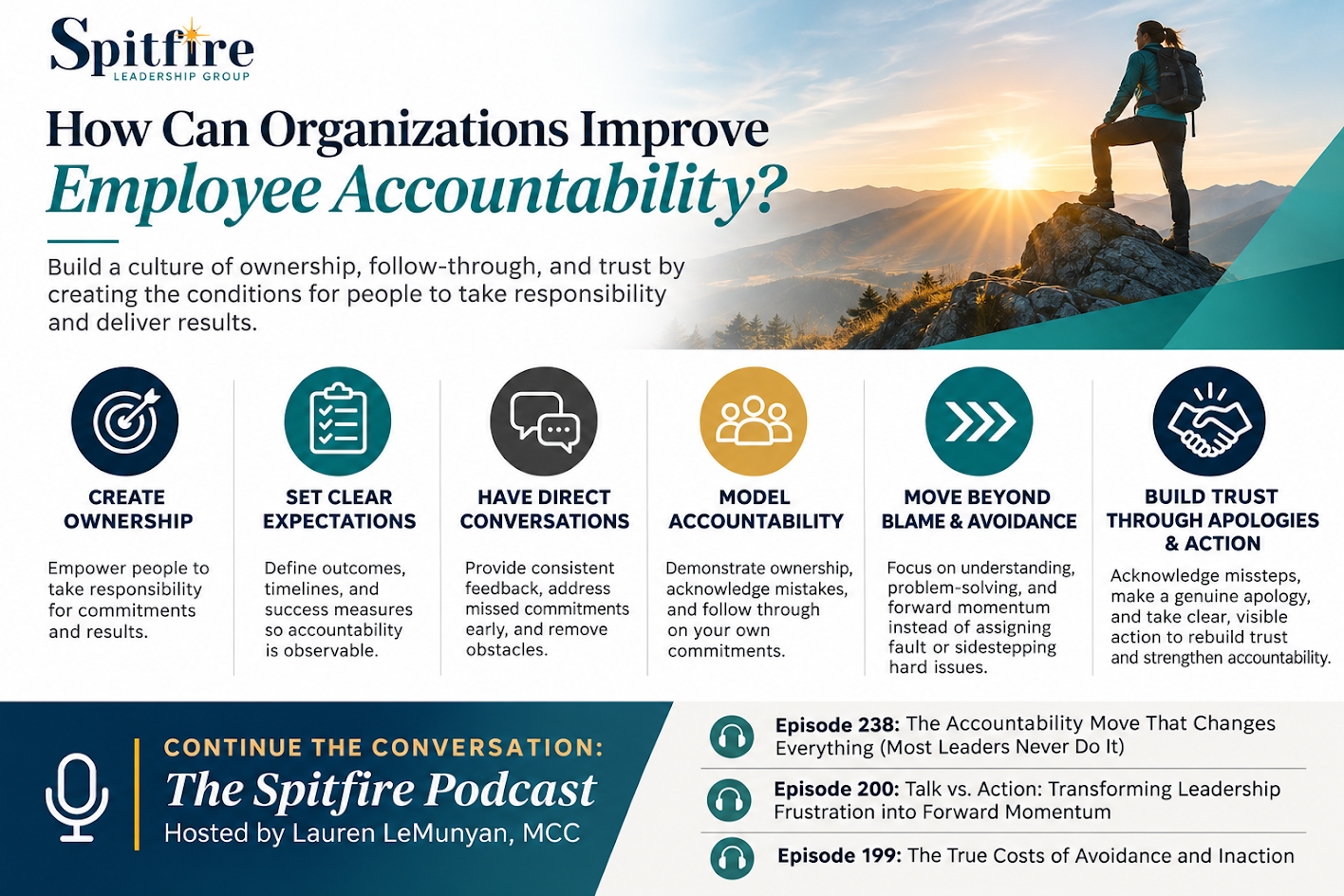
Organizations improve employee accountability by establishing clear expectations, defining ownership, providing appropriate resources, reinforcing consistent feedback, and creating an environment where individuals take responsibility for commitments and results.
When leaders describe an accountability problem, they often focus on employee behavior.
People miss deadlines.
Commitments go unfulfilled.
Work requires repeated follow-up.
Managers become frustrated.
But accountability problems are not always caused by a lack of employee motivation or commitment.
They can also result from unclear expectations, competing priorities, inconsistent leadership, insufficient resources, or organizational systems that make ownership difficult.
Improving accountability requires examining both individual responsibility and the conditions leaders create.
1. Define What Accountability Actually Means
Accountability is often confused with compliance.
Compliance focuses on following instructions and meeting requirements.
Accountability involves taking ownership of commitments, communicating progress, identifying obstacles, and addressing results.
In an accountable organization, employees understand what they are responsible for and have the authority and support necessary to deliver.
Accountability is not about assigning blame when something goes wrong.
It is about creating clarity, ownership, and follow-through.
2. Establish Clear Expectations
Employees cannot consistently meet expectations that have not been clearly communicated.
Leaders should define desired outcomes, deadlines, quality standards, decision-making authority, and relevant constraints.
Vague requests such as "take ownership" or "be more proactive" are difficult to evaluate.
Specific expectations make accountability observable.
For example, instead of asking a manager to improve communication, a leader might establish an expectation that project risks will be escalated within one business day of identification.
Clarity reduces ambiguity and creates a shared understanding of success.
3. Align Responsibility With Authority
One of the most common organizational accountability problems occurs when employees are responsible for outcomes they cannot meaningfully influence.
A project leader may be accountable for delivery without having authority over resources, priorities, or critical decisions.
This creates frustration and can encourage defensive behavior.
Leaders should examine whether individuals have the information, authority, support, and capacity necessary to meet expectations.
Accountability without appropriate authority is often ineffective.
4. Build Consistent Feedback and Follow-Through
Accountability requires regular communication.
Waiting until annual performance reviews to address missed expectations allows problems to persist.
Effective leaders establish predictable check-ins focused on progress, obstacles, decisions, and support.
These conversations should be constructive and specific.
When commitments are missed, leaders should seek to understand the cause before determining the appropriate response.
Was the expectation unclear? Did priorities change? Were resources insufficient? Was there a capability gap? Or did the individual fail to follow through on a reasonable commitment?
Different causes require different interventions.
5. Model Accountability at Every Leadership Level
Employees notice when leaders hold others to standards they do not follow themselves.
A senior executive who routinely misses commitments, avoids difficult conversations, or shifts blame can undermine accountability throughout the organization.
Leadership accountability includes acknowledging mistakes, communicating changes, honoring commitments, and taking responsibility for decisions.
When leaders demonstrate these behaviors consistently, they establish a stronger foundation for accountability across teams.
6. Replace Micromanagement With Ownership
Managers sometimes respond to missed expectations by increasing oversight.
While closer supervision may be necessary in certain situations, excessive monitoring can reduce autonomy and create dependence.
A more sustainable approach involves establishing clear outcomes, agreeing on milestones, and giving employees appropriate freedom to determine how work gets done.
Leaders should distinguish between monitoring results and controlling every action.
The goal is to create ownership, not dependence.
7. Reinforce Accountability Through Organizational Systems
Accountability should be reflected in performance management, recognition, project planning, and leadership expectations.
Organizations should recognize reliable follow-through, proactive problem-solving, and transparent communication.
They must also address repeated performance issues fairly and consistently.
Without consistent reinforcement, accountability becomes dependent on individual managers rather than an organizational standard.
Boiling It Down
Strong accountability cultures are built through clarity, trust, consistent leadership, and shared responsibility.
Organizations do not improve accountability simply by demanding more from employees.
They improve it by creating the conditions in which people understand expectations, have the ability to deliver, and take ownership of their commitments.
At Spitfire Leadership Group, we help organizations develop the leadership and management capabilities that support accountability, stronger team performance, and sustainable results.
If accountability is a recurring challenge in your organization, start by examining the expectations, behaviors, and systems that shape employee performance.
Continue the Conversation: The Spitfire Podcast
"The Accountability Move That Changes Everything (most leaders never do it)."
This episode helps leaders navigate workplace conflict and build psychological safety by taking accountability, listening without defensiveness, and offering clear, sincere apologies. https://open.spotify.com/episode/3EYKwvrzBeLFwLNmUWGy29?si=4fc358cf9e344b6c
"Talk vs. Action: Transforming Leadership Frustration into Forward Momentum"
This episode helps leaders bridge the gap between discussion and action by setting clear meeting objectives, encouraging purposeful questions, and managing expectations to drive team progress. https://open.spotify.com/episode/3xjWGdZlDS04nj6d5CsHh5?si=_04_XDSKQVGQTSoEQLWqXg
"The True Costs Of Avoidance and Inaction"
This episode offers practical strategies for leaders to turn endless discussions into meaningful action through clear objectives, focused meetings, thoughtful questions, and effective expectation management. https://open.spotify.com/episode/1x1AqZkpv2ZKZ6FnDzU8sN?si=ed43ebd1d4c34e0e
About the Author
Lauren LeMunyan, MCC, is the Founder and CEO of Spitfire Leadership Group, an adaptive leadership development firm specializing in Skill Gap Analysis, Upskilling, Leadership Development, and Executive Advisory. With more than a decade of executive coaching experience, Lauren helps leaders and organizations navigate complexity, strengthen performance, and build future-ready leadership capabilities. She is also the host of The Spitfire Podcast, where she explores the human side of leadership, business, and personal growth.