

Episode 127: How to Get 25% More Time in Your Day
The average people manager spends 25% or more of their day dealing with people conflict and in a VUCA environment (volatile, uncertain, complex, and ambiguous) aka 2020, this number has skyrocketed. Now while you may not be dealing with direct employee infighting or passive aggressive behaviors in the hallway, conflict and friction are impacting your energy and motivation in ways you may not be thinking about.
Did you know there is no such thing as laziness or procrastination? So what is really getting in the way of you checking off your To Do List or completing those big projects?
Hear the truth around productivity and how you can get 25% or more done in a day without any software, extra resources or magic wand.
Learn how to:
Better understand your productivity pitfalls
Organize your day to work for your preferences
Handle uncertainty and change throughout your day
Leverage micro-shifts to create sustainable positive behavior changes

Episode 126: What I Really Think About Resolutions
As 2020 winds down, the urge to create resolutions ramps up. Hear what Lauren really thinks about resolutions and what she recommends for her clients instead.
Episode 125: Envisioning an Awesome New Year with Caz Gaddis

Lauren chats it up with fellow coach and co-author, Caz Gaddis, the founder of More Than a Parent and Vision Board in a Box.
From expectations and labels, to converting vision into action, Caz and Lauren unpack the mental and emotional blocks that are really holding people back from living the life they want.
Vision Board In A Box is not just about collecting pretty images for a collage. It's a manifestation framework to help you become who you need to be in order to do, have, and what you desire for yourself.

Episode 124: How Can I Feel More Productive?
Anyone else feel like their productivity is way down this year?
You're not alone.
In fact, all of my clients have complained about a lack of energy, motivation and focus.
So how do we get more done when it feels like everything is too overwhelming?

Episode 123: How to Shut Down Toxicity in Teams
Are you ready to clean up the toxicity in your team?
The drama, the gossip, the negativity - it's just too much.
In today's episode, Lauren breaks down the three types of employee vibes and how to address and extract the toxic energy and improve employee morale and the team's culture.

Are you ready to clean up the toxicity in your team?
The drama, the gossip, the negativity - it's just too much.
In today's episode, Lauren breaks down the three types of employee vibes and how to address and extract the toxic energy and improve employee morale and the team's culture.

Episode 122: The Day After...
What do we do when we don’t know what to do?

What do we do now?

Episode 121: How Can We Make Things Easier?
Does everything really have to be so hard?
Where may you be adding additional loads to your already full plate?

Why does everything have to be so hard?
Why can't there be an easy button?
In today's episode Lauren shares a visualization tool to help you inject a little easy into your life.

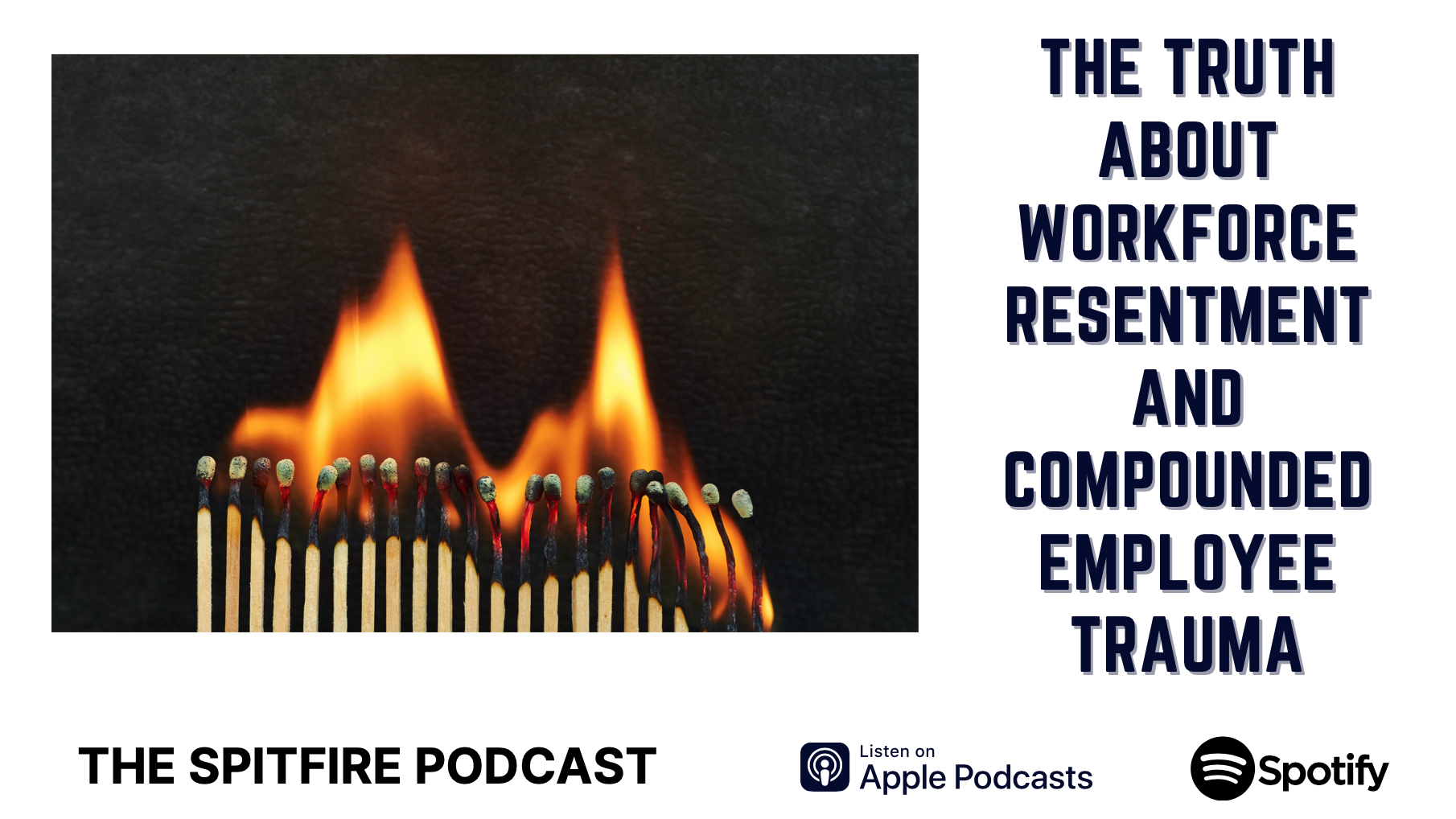
Episode 120: Compounded Employment Trauma and The Impacts of Workplace Resentment
Raise your hand if you've ever...
Rolled your eyes when someone was speaking.
Been super annoyed when a client messages you.
Gotten agitated at the sight of a name in your inbox.
Blown up at a colleague.
Raise your hand if any of those things have happened to you.
Raise your hand if you've ever...
Rolled your eyes when someone was speaking.
Been super annoyed when a client messages you.
Gotten agitated at the sight of a name in your inbox.
Blown up at a colleague.
Raise your hand if any of those things have happened to you.
My guess is most if not all of you who are reading this have been on the giving and or receiving end of resentments in the workplace.
Today we're talking about the compounded effects and what you can do to stop the cycle.

Episode 119: How to Increase Engagement in Your Zoom Meetings
On average, how many meetings are you having a week?
For my clients, they are in 12-20 Zoom meetings a week. Multiple that by the average time (1 hour) and that's half the time they're supposed to be working, but instead are sitting on meetings.
For many it feels like Groundhog Day. The same topics. The same issues. The same people "venting" but accomplishing nothing.
So how do we spark up the engagement in meetings? No, it's not icebreaker exercises, but it does involve a precise action.

On average, how many meetings are you having a week?
For my clients, they are in 12-20 Zoom meetings a week. Multiple that by the average time (1 hour) and that's half the time they're supposed to be working, but instead are sitting on meetings.
For many it feels like Groundhog Day. The same topics. The same issues. The same people "venting" but accomplishing nothing.
So how do we spark up the engagement in meetings? No, it's not icebreaker exercises, but it does involve a precise action.

Episode 118: How Diverse and Inclusive are Your Zoom Meetings?
Those rectangles on your screen are exposing the truth about your organization’s diversity, equity and inclusion. Are you ready to hear it?
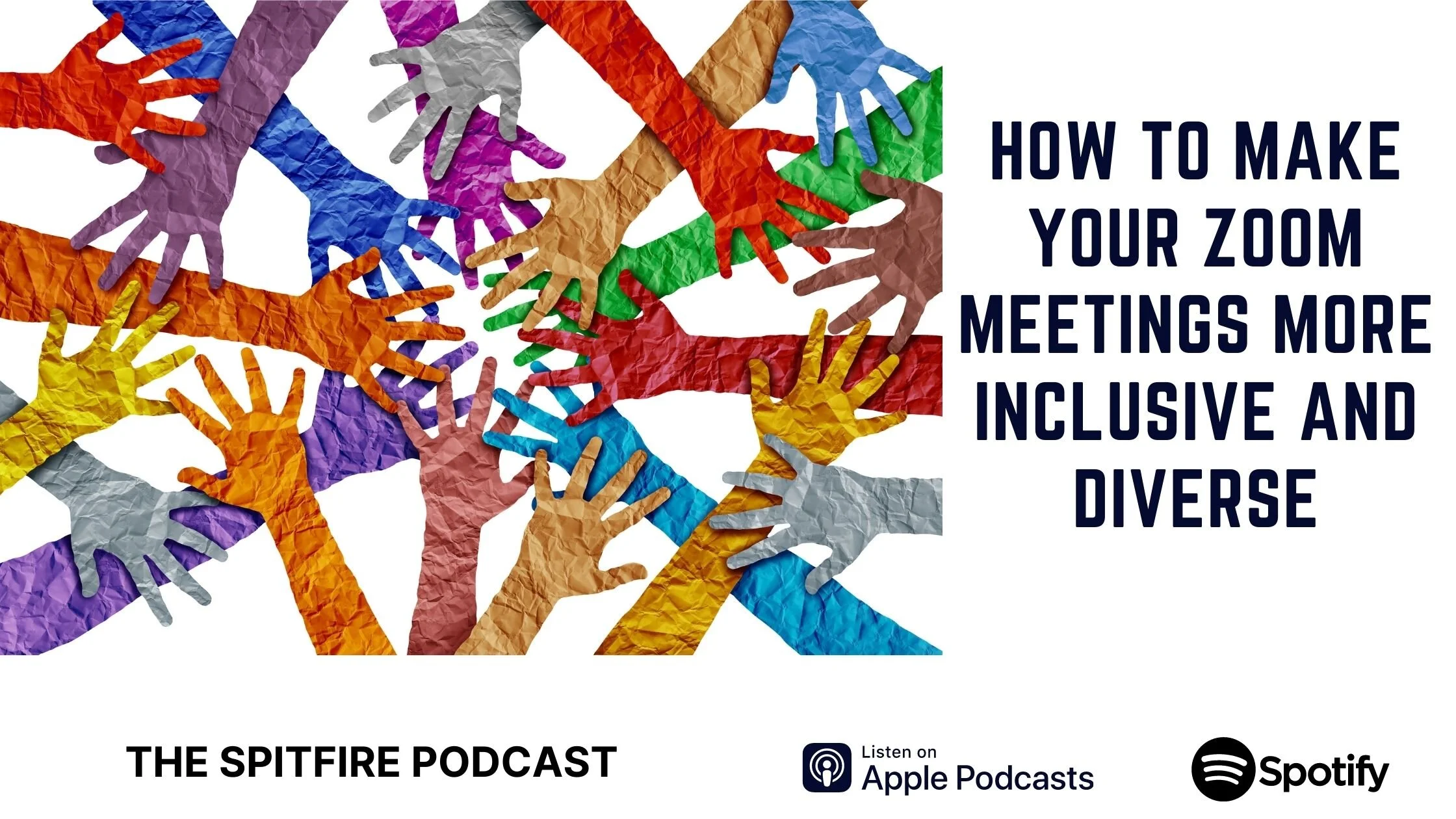
Now more than ever, companies are paying attention to their Diversity, Equity and Inclusion. But what does it all mean?
More people of color?
More LGBTQ+?
More women?
More religious representation?
Diversity is about more than changing stock images on a website and the bullet points of a mission statement.
You can see how diversity, equity and inclusive a company is by observing a Zoom meeting. (I would say Board meeting, but most of us are not meeting in person.)
Notice who is speaking. Notice who is not. Notice the reactions and body language shifts. Notice who has their camera on. All of these are signals of who feels safe, included and acknowledged.
In today's episode, I'm sharing tips on how you can shift your meetings to be more diverse, equitable, inclusive and productive.

Episode 117: Stop Coaching Scared
"Such great info packed into an hour. All the points were still applicable to me even though I am not a coach."

"Such great info packed into an hour. All the points were still applicable to me even though I am not a coach."
"Wonderful and timely tips. It was easy for me to make the transition to my sales profession."
Take a Listen and Learn:
•Where and How Fears Shows up
•The 5 Signs of Fear in Your Coaching
•5 Ways to Manage the The Fears When They Appear

Episode 116: Taking Stock of Your Awesomeness
It can be so easy to track what's not going right or what we haven't done.
I am soooo guilty of this. In fact today, someone called me out!
I have spent years creating, generating, and connecting and I gave myself NO CREDIT!
I kept thinking I was missing something and had to create it from scratch. That was until I took inventory of my awesomeness!

It can be so easy to track what's not going right or what we haven't done.
I am soooo guilty of this. In fact today, someone called me out!
I have spent years creating, generating, and connecting and I gave myself NO CREDIT!
I kept thinking I was missing something and had to create it from scratch. That was until I took inventory of my awesomeness!

Episode 115: How to Allow Your Business to Succeed
Think you can't be successful in a pandemic? You'll be right.
Want to be successful even with constraints?
Listen to what one of Lauren's clients did to make their total earnings of 2019 in one month.
Lauren shares the secret ingredients of her success and what you can do about it in your own business.

Think you can't be successful in a pandemic? You'll be right.
Want to be successful even with constraints?
Listen to what one of Lauren's clients did to make their total earnings in 2019 in one month.
Lauren shares the secret ingredients of her success and what you can do about it in your own business.

Episode 114: Using Your Feels to Resolve Your Blindspots
Feelings... we've all got em. Some feel good, some not so much.
Feeling frustrated because something didn't go your way?
In today's episode we're talking about how to leverage those icky feeling ones to give us insights on our blindspots.

Feelings... we've all got em. Some feel good, some not so much.
Feeling frustrated because something didn't go your way?
In today's episode we're talking about how to leverage those icky feeling ones to give us insights on our blindspots.
Say goodbye to the stuck and get ready to move!

Episode 113: Where Are You in Your Pandemic Journey?
We are all trying to do the best with what we have.
After five months of business slumps and changes, it can feel like everything is falling apart. If you’re out of work, it can feel dire. If your business has dipped, it can feel hopeless and frustrating. Even if you have your job, your working environment and downtime has changed.
Today we’re talking about the three phases of your pandemic journey and how acknowledging where you are in your process can help you.

We are all trying to do the best with what we have.
After five months of business slumps and changes, it can feel like everything is falling apart. If you’re out of work, it can feel dire. If your business has dipped, it can feel hopeless and frustrating. Even if you have your job, your working environment and downtime has changed.
Today we’re talking about the three phases of your pandemic journey and how acknowledging where you are in your process can help you.

Episode 112: A Deep Dive with Ashley Powdar, Ruby Sampson
Lauren sits down with the creative force behind Ruby Sampson - a global fashion utility brand for textured-hair women. Hear how Ashley Powdar took the lemons of a botched order and used it to propel her into the next phase of her business and as a business owner.

Lauren sits down with the creative force behind Ruby Sampson - a global fashion utility brand for textured-hair women. Hear how Ashley Powdar took the lemons of a botched order and used it to propel her into the next phase of her business and as a business owner.
Subscribe to The SpitFire Podcast at www.spitfirepodcast.com or on Apple Podcast or Spotify.
About Ruby Sampson www.rubysampson.com
Ruby Sampson is a fashion utility brand for textured-hair women. We exist to bring thoughtfully crafted designs to the lifestyle and hair needs of women of color. In 2012 we launched our minimum viable product, the silk-lined headwrap, for women with natural hair who experience chronic dryness and breakage. Ruby Sampson is the namesake of Ashley’s grandmother, who was a seamstress and family matriarch of 8 children in Georgetown, Guyana.
Ashley’s parents immigrated to the United States in the early 1980’s and instilled an unwavering work ethic and sense of gratitude for opportunity. The brand attributes include resilience, ambition, risk, failure, and success: shared pillars of the family’s immigrant passage.
The brand is inspired by and devoted to women of color. We love to play with unconventional textiles and bold prints that introduce a level of utility and sophistication to the customer’s wardrobe. Ruby Sampson caters to the customer’s ambitious nature by reducing the time needed to regain hair health and freeing up resources to refocus energy on causes that matter. Ruby Sampson was officially founded in Washington, DC in 2016 and is a member of The Made In DC Program.

Episode 111: How to Build Trust Remotely
We can't lose the human level of this technology and communication shift. In fact, we need to leverage our human connection even more.
The way that we're seeing and hearing people are different and it's going to be different for a while. But what if the way we connect with people now can help us deepen our relationships with people in the future.
What if the points and the principles we are learning and creating can help us all adjust when new catalysts of change happen?
How do we build trust? How do we communicate? How do we defuse conflict? How do we see and hear people?

This is Episode 111 and I've listened back to a couple of these episodes. I've looked at the titles to think, you know, what would be changed, if anything and what I was saying and not a lot has changed as far as the things that are most important to us.
These are universal principles that can be adapted in any environment. It's mainly how do we show up in the way that we want to how do we get the best result from The people that are working around us by igniting the best in them.
How do we build trust? How do we communicate? How do we defuse conflict? How do we see and hear people?
Now the way that we're seeing and hearing people are different. It's going to be different for a while. And even when whatever normal comes back, it's going to be different, too. But these are the points and the principles that are going to help us all adjust when these new catalysts of change happen.
So today, we're going to talk about something that came up in my coaching session just before this, and it's talking to all about trust. He is someone who travels a lot every four to six weeks, he is going in an office in his company on in another part of the world. There is a lot of relationship building that's happening in casual water cooler conversations or in networking that's happening outside of the office.
Obviously we can't do that now. We can't pull people aside. We can't have a drink with them. We can't invite them to a meal in a pub or restaurant. We're not necessarily just happening to have casual run ins with people. This is a time where we need to be really intentional and deliberate.
So I wanted to kind of peel back the layers and see where the value is in this casual, organic or serendipitous meeting. Where's the value that this individual is getting?
For him, it came down to building trust to having a human to human connection that gets lost when we're only focused on building agendas. We're not really seeing people, if we're they're just accomplishing tasks and and stating what our objectives are.
This is an opportunity for us to look at how do we go from one extreme and then the other extreme so going from hyper professional and hyper casual what is that in between Let's be honest, we're not wearing our business suits to zoom calls or conference calls, most of us, maybe not, haven't even showered, or hopefully we've brushed our teeth. But we're not showing up in kind of our armor. We're not showing up in this professional attire, that's even giving the impression that things are similar.
We can have an in between that can merge the benefits from having professional objectives and also bring our very human and casual self into it, which allows us to build trust.
During our session I said, “You know, you mentioned the word trust. So tell me what the building blocks of trust are for you?.
He said, “Well, I think it might be empathy or might be sympathy.”
He went back to empathy, so I asked him, “What does empathy mean to you?”
And he said, “Well, it's giving it to get it. So by sharing vulnerability by sharing personal things that you're comfortable with, it allows other people to connect with you.”
BINGO!
When we get to show up as ourselves, it signals to the other person. “Well, I can show up as myself too.”
That’s the first piece. Being the example of what you want to see and experience.
Then there’s keeping your word. If you don't keep your word, if you say you're going to do something and you don't do it, then that immediately is a trust killer.
Also, reciprocation. If someone doesn't reciprocate trust, then that is a trust killer.
Where we go wrong is when we assume there is established trust without basis. When we assume that the person sitting across from us or having the conversation has the same expectation and perceived outcome, and has an understanding of what we're doing, but there's never a communication or a shared agreement. And then we're not balanced. That's where things go awry.
All relationships break down from unmet expectations. This is where we can get curious and clarifying and verifying, and also bringing ourselves into it can really help to build trust.
So we think about seeing people for who they are, and honoring that piece of them, and also being really clear about what it is we need from them. What is it that we're willing to give? What is it that we would like to get from them?
This way we can create these shared agreements, we can create shared expectations that helped to build trust. It can take a long time to build trust, and and it probably should, we have proximities of trust to us, the people who are closest to us - those have been tried and tested over years. You know, those people that you've known for 10 years plus, that you don't have to necessarily keep tabs with every day or every week or even every month, but you know that when you come back together, the trust is still the same Because you have that shared understanding, you have shared operating principles.
There are people that you feel connected to, but trust needs to be. It needs to be verified over time. That's where these check ins on the agreements happen. That's why we review contracts. If we're in business, we're not just signing a document and walking away from it, we're going back to check on. Okay, well, what does reciprocity look like? How do I get what I need? Is this person getting what they need? And that's okay. But if we want to deepen relationships with people, we have to put ourselves out there in order to signal to other people that it's okay for them to do the same.
So just because we're not having face to face, drinks with people, we're not necessarily having those those passing moments in the hallway or are those moments at a conference that you know in a buffet line to crack a joke, we are still able to connect with people. But the two key things are we have to be intentional and we have to be deliberate This is where setting the intention before every single engagement we have with the question of how do I use this opportunity to build trust? How do I need to show up? And what does success look like for me? How do I know when I deepen trust, you will know energetically when this starts to happen.
We want to feel trust on a gradual level, that deepening that stretching that growing. You will know it when you feel it. But know that over time, each step that you make towards this, the more sustainable and manageable it is. This time period is all about R&R, what is realistic and what is reasonable and being face to face being in person with people is not it's just not realistic right now. But we can still have conversations, we can still have different types of conversations that deepen our trust, we can still get to know people, we can acknowledge and validate them, we can see and hear them.
We can't lose the human level of this technology and communication shift. In fact, we need to leverage our human connection even more.
As you're navigating this, if you're working from home, or if you're in the job hunt, or you're just trying to get by, you can use this with your friends and family, you can use this with colleagues thinking about how can I connect with this person on a more human level? How do I share a little bit more of me? And how do I get curious with them to learn more and appreciate more about them?
We are all diverse, dynamic, multifaceted beings and it's our opportunity now to stop seeing things on the surface level and to start taking a deeper and more appreciative look at what is around us.
I hope that all of you are safe and well, if you have any questions if you need any more resources, I have set up a page with telework. Working for teams or individuals to navigate this uncertain unprecedent time, whatever you want to call it at the remote leader.com we just did something on routine reset, you can schedule a complimentary routine reset with me for 15 minutes. And if you have any questions, let me know if you're if you're struggling with anything, ask me the question. I'm happy to answer it on a future podcast and to all the Spitfires out there. Keep being awesome!

Episode 110: Routine Reset: Creating a New Workflow in Abnormal Times
Everything may look the same, but everything is different.
What may have worked for us before may actually be contributing to our stress and feelings of burnout.
In this episode Lauren will walk you through her Routine Reset process and worksheet (also available here: https://spitfireinstitute.com/wp-content/uploads/2020/04/Routine-Reset-Worksheet-SpitFire-Institute-042020.pdf)

Everything may look the same, but everything is different.
What may have worked for us before may actually be contributing to our stress and feelings of burnout.
In this episode Lauren will walk you through her Routine Reset process and worksheet (also available here: https://spitfireinstitute.com/wp-content/uploads/2020/04/Routine-Reset-Worksheet-SpitFire-Institute-042020.pdf)
Schedule a Routine Reset Sesh here - https://laurenlemunyan.as.me/routinereset
Episode 109: Finding the Pockets of Opportunity in Uncertainty
To say that things feel different would be an understatement. To say that people feel unsettled would be the tip of the iceberg.
The past few weeks have built up to a crescendo of cancellations, fear, and uncertainty.
So, what do we do when everything feels scary and unknown?
Lauren shares the four questions you can ask yourself to get back to what matters and convert uncertainty into empowerment.

To say that things feel different would be an understatement. To say that people feel unsettled would be the tip of the iceberg.
The past few weeks have built up to a crescendo of cancellations, fear, and uncertainty.
So, what do we do when everything feels scary and unknown?
Lauren shares the four questions you can ask yourself to get back to what matters and convert uncertainty into empowerment.
Full article: https://associationchat.com/2020/03/13/finding-pockets-of-opportunity/
Living Room Concerts: www.facebook.com/justintrawickmusic

Episode 108: Favor Faux Pas
"I’m hosting a workshop at work with a colleague who is a life and health coach as well. We are both volunteering our time for this. I asked a good friend of mine (also a colleague) to design the flyer. She did a great job. It is my hunch that my colleague wants to use the design for her own future gain, whether to advertise for other volunteer sessions she offers at the company or through her paid coaching services.
She then asked my designer friend to share the source files and asked the designing colleague to coffee for future "collaborations."
This doesn't sit well with me and I feel like my designer friend will be taken advantage of. How do I educate someone in a kind way about pro bono design work and intellectual property boundaries?"

This week we're responding to a question from a listener:
"Pro Bono No-No"
"I’m hosting a workshop at work with a colleague who is a life and health coach as well. We are both volunteering our time for this. I asked a good friend of mine (also a colleague) to design the flyer. She did a great job. It is my hunch that my colleague wants to use the design for her own future gain, whether to advertise for other volunteer sessions she offers at the company or through her paid coaching services.
She then asked my designer friend to share the source files and asked the designing colleague to coffee for future "collaborations."
This doesn't sit well with me and I feel like my designer friend will be taken advantage of. How do I educate someone in a kind way about pro bono design work and intellectual property boundaries?"